
by Narissa Phelps for the Lennox Wave
Acknowledging information contained in Lennox Head Public School Centenary 1882* and the research of Sara Maroske, particularly A taste for botanic science’: Ferdinand Mueller’s female collectors and the history of Australian Botany.
Mary Hodgkinson arrived in the Lennox district in 1866, one of the area’s earliest settlers. Despite remaining largely unacknowledged—overshadowed in the histories by her better-known husband, James Hodgkinson—Mary demonstrated a fascination with botany which set her apart from other North Creek pioneering women.
Born in London on 23 August 1823, Mary was the third of four children born to Thomas and Sarah Marshall. The family migrated to Victoria in 1840, Thomas working as a land commission agent for his brother John Marshall, a well-known British emigration contractor. After being declared bankrupt during the 1840’s depression, Thomas and his family moved to Geelong where Mary was to meet James Hodgkinson. The couple married in 1843, remaining in Victoria where they engaged in farming. By 1864, the couple owned five stations in the Avoca and Swan Hill districts, however the mortgages were large and insolvency followed. It appears that the financial struggles experienced by both Mary’s father and her husband had a deep impact on her. In a letter written many years later to her daughter, Mary wrote:
Maidenhood is preferable to being united to extreme poverty unless a man has thoroughly good principles, known to be such and an amiable disposition. Promises are not worth a feather’s weight, facts, look for facts in that line. If they are not walking in the way that leads to glory when they are courting, they will not after, or the chances are very slender.*
These words reflect a depth of wisdom born of experience and speak to Mary’s practicality as well as her independence.
It was against this background of insolvency that Mary and James Hodgkinson, and three of their eight children, moved to North Creek (Lennox), in 1866. Their property extended from the Lennox Headland to North Creek Road, a total of 1,316 acres. As one of Lennox Head’s earliest settlers, conditions would have been challenging for Mary. Building a house, clearing the land for farming, planting gardens to grow vegetables and an orchard for fruit—all whilst rearing children and assisting her husband. Her early years on the property would have been demanding.
Just four years after moving to the Lennox headland, Mary became a female collector for botanist Ferdinand von Mueller. Based in Melbourne, Mueller’s desire to write about Australian flora necessitated the employment of a team of botanical collectors. In return for their labours, Mueller would hone their knowledge and skills in botany. Regarded in the 19th century as one of the more ‘suitable’ sciences for women’s participation, female botanists were nevertheless relegated to the ranks of amateurs or hobbyists. Collectors in rural areas, and particularly newly settled areas like North Creek, were particularly valued by Mueller given the likelihood that they would discover new species.
Mary began her association with Mueller in 1870, and by 1875 had collected previously unidentified species, included Eugenia hodgkinsoniae F.Muell, a rare subtropical Red Lilly Pilly, named for her. By far her greatest area of interest and expertise appears to be in the collecting of fungi. In 1880 alone, she collected fifteen different types of fungi, triggering Mueller’s interest in fungi of the type collected by Mary. Her active engagement in botany over an 18-year period, and the fact that she inspired her daughter Virginia (Nina) to become a collector, proves the success of Mueller’s program of engaging women in the science of collecting. Mueller recognised Mary’s achievements by presenting her with a copy of his book, Select extra-tropical Plants in 1885, four years before her death in 1889.
Mary was no ordinary pioneering settler. Her apparent intellect, drive and determination to extend her boundaries beyond the confines of home and farm, distinguish her as a woman of independence and self-determination. She should be acknowledged and remembered for her contribution, not only to the region, but to the science of botany.
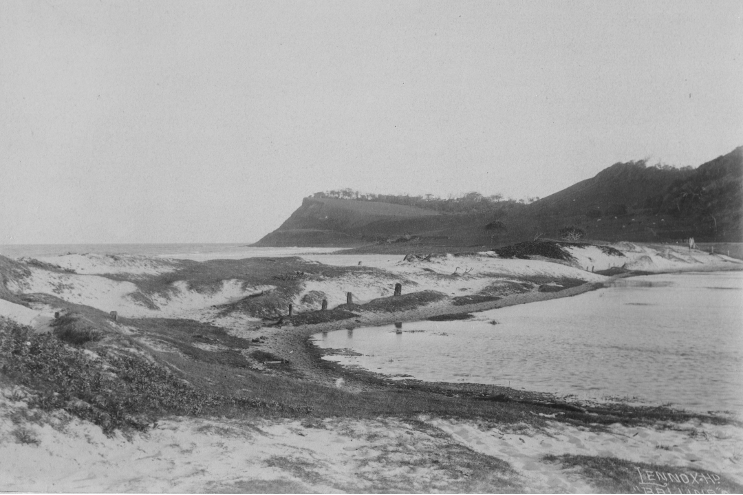
An early photograph of the Lennox headland, the farm of the Hodgkinson family from 1866. Photo courtesy of Richmond River Historical Society.


 Colonial Australia's Early History
Leave a comment